ابحث في المحطة بأكملها
Freeze drying, or lyophilization, is one of the most reliable ways to preserve delicate biological, pharmaceutical, and chemical samples without damaging their structure or activity. For research institutions, pharmaceutical developers, biotech startups, and quality control labs, a well-chosen laboratory freeze dryer isn’t just a piece of equipment — it’s often the single most important step standing between a sensitive sample and a usable, stable, long-term result.
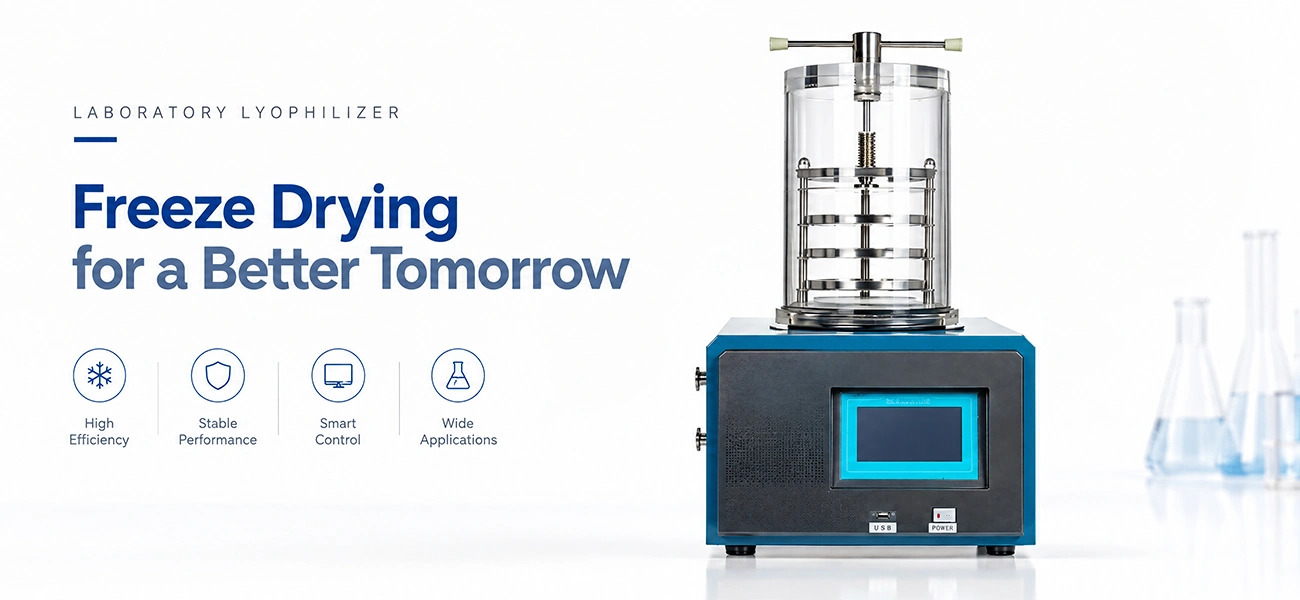
A laboratory freeze dryer removes water (or another solvent) from a frozen sample through sublimation — the direct transition of a solid to a gas without passing through a liquid phase. This is critical for samples that would be damaged, denatured, or structurally altered by conventional heat-based drying.
The process happens in three main stages. First, the sample is frozen solid, either inside the freeze dryer itself or in a pre-freezer, at temperatures typically between -40°C and -80°C depending on the material. Second, a vacuum pump lowers the chamber pressure dramatically while a controlled amount of heat is applied — just enough to drive sublimation without allowing the sample to thaw. Third, the water vapor released during sublimation travels to a refrigerated condenser, where it re-freezes onto the coil, keeping it from reaching (and damaging) the vacuum pump.
Because the entire process happens at low temperature and low pressure, a lab freeze dryer preserves the molecular structure, biological activity, and chemical composition of the sample far better than oven drying, air drying, or heat-based evaporation ever could. This is why lyophilization has become the gold standard across pharmaceutical formulation, microbiology, biochemistry, and diagnostics.safely process highly corrosive or high-purity chemistries at industrial scale, something stainless steel or even many exotic alloys cannot reliably do for extended periods.
Traditional industrial-scale freeze dryers demand dedicated floor space, specialized ventilation, and often a separate utility room. Most academic labs, startup R&D facilities, and quality-control departments simply don’t have that kind of room to spare. A benchtop freeze dryer solves this problem directly — it fits on a standard lab bench, cart, or shared workspace, drawing standard laboratory power while still delivering research-grade vacuum and condenser performance.
Industrial freeze drying systems represent a massive capital investment, often justified only by continuous, high-volume production runs. For labs running smaller batches — a handful of vials, a rack of sample trays, or a rotating manifold of flasks — a lab freeze dryer sized appropriately for benchtop use delivers the same fundamental sublimation science at a fraction of the acquisition cost, maintenance overhead, and facility requirements.
A single laboratory freeze dryer can move between very different jobs from one week to the next: freeze drying bacterial cultures for long-term storage on Monday, stabilizing a protein formulation on Wednesday, and preserving plant or tissue samples for later analysis on Friday. Benchtop units are typically designed with interchangeable accessories — manifolds, tray dryers, chamber shelves — that let a single machine adapt to whatever the research calls for that day.
Because a benchtop freeze dryer handles smaller sample volumes, cycle times and setup logistics are often faster than loading and managing a large industrial unit for the same size batch. Labs running frequent, varied, smaller-scale work get equipment turnover that matches their actual pace of research rather than sitting idle waiting to justify a full industrial-scale run.
Industrial systems typically require permanent plumbing, dedicated electrical circuits, and structural planning before installation. A compact lab freeze dryer can usually be relocated between labs, moved to a new facility, or reconfigured within a shared space without the disruption or cost associated with moving industrial equipment — a meaningful advantage for growing labs, shared-use facilities, or institutions that reorganize research space frequently.
Not every laboratory freeze dryer is built for the same workload. Matching specifications to your actual sample types and throughput needs is the difference between a machine that becomes indispensable and one that becomes a bottleneck.
Condenser temperature determines how effectively the unit captures water vapor during sublimation, which directly affects both cycle time and end-product quality. Standard benchtop units typically offer condenser temperatures in the -50°C to -85°C range. Lower-temperature condensers are essential for samples with low eutectic points, such as certain biological buffers, organic solvents, or high-salt-concentration formulations, since these require deeper cold traps to fully capture vapor without allowing it to escape back into the chamber or damage the pump.
Beyond just temperature, condenser ice capacity — how much total moisture the coil can capture before needing a defrost cycle — determines how large a batch you can realistically run in one cycle. Labs processing higher sample volumes should prioritize units with higher-liter condenser capacities to avoid mid-cycle interruptions.
The vacuum pump’s ultimate vacuum level and pumping speed directly influence cycle time and sublimation efficiency. Oil-sealed rotary vane pumps are common on benchtop systems and offer strong performance for most general lab applications, while oil-free or scroll pump options are increasingly popular for labs concerned about oil vapor contamination in sensitive chemical or pharmaceutical work.
For labs working with formulation development, pharmaceutical stability studies, or any application requiring controlled primary drying, look for a lab freeze dryer with programmable, temperature-controlled shelves. This allows precise control over shelf temperature ramps during primary and secondary drying — a critical feature for cycle optimization and reproducibility in regulated environments.
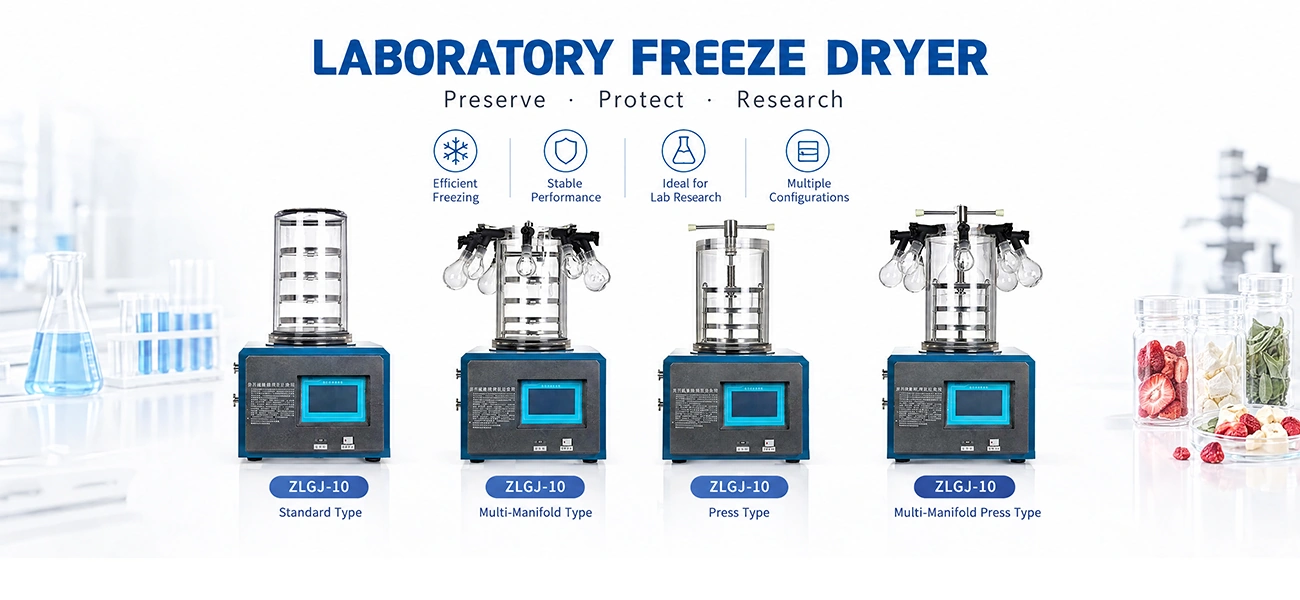
Different sample formats require different drying configurations:
A versatile benchtop freeze dryer often supports multiple configurations through interchangeable accessories, letting one unit serve several departments or research programs.
Regulated environments — pharmaceutical development, GMP-adjacent research, and quality-controlled production — increasingly require documented, reproducible cycle data. Look for units offering programmable multi-step cycles, real-time temperature and pressure logging, and export capability for compliance documentation and process validation.
Since a lab freeze dryer often runs for 24 hours or longer per cycle in a shared workspace, noise level and physical footprint matter more than they might seem to at first glance. Compact, well-insulated benchtop units minimize disruption to other work happening nearby, which is especially relevant in open-plan or multi-user lab environments.
Lyophilization is a cornerstone technique in pharmaceutical development, used to stabilize proteins, peptides, vaccines, and other biologics that would degrade in liquid form during storage or shipping. A laboratory freeze dryer with precise shelf temperature control and stoppering capability supports formulation studies, stability testing, and small-batch production runs during early-stage development.
Freeze drying is widely used to preserve bacterial cultures, yeast strains, and other microorganisms for long-term storage without the need for continuous cryogenic freezing. A properly freeze dried culture can remain viable for years when rehydrated under appropriate conditions, making a lab freeze dryer a standard tool in culture collections, diagnostic labs, and academic microbiology departments.
Beyond biological samples, freeze drying is used to prepare porous materials, remove solvents from sensitive chemical compounds, and produce fine powders from solution-based samples for further analysis. The gentle, low-temperature process avoids the thermal degradation or structural collapse that heat-based drying methods often cause.
Research labs working with plant material, tissue samples, or environmental specimens frequently use freeze drying to preserve samples for later molecular analysis, since the process avoids the enzymatic degradation and structural distortion associated with conventional drying or improper freezing.
University and industrial food science departments use benchtop freeze dryer units to prepare samples for nutritional analysis, moisture content studies, and shelf-life research, since freeze drying provides a controlled, repeatable method for removing moisture without altering the chemical composition being studied.
Freeze dried reagents and diagnostic components have longer shelf lives and don’t require cold-chain shipping in the same way liquid reagents do. Many diagnostics companies and reagent manufacturers rely on a lab freeze dryer to stabilize components for point-of-care test kits and laboratory reagent products.
Understanding where a benchtop freeze dryer fits relative to industrial-scale systems helps clarify whether it’s the right choice for your facility.
Batch Size: Industrial systems are built for continuous or large-batch production, often processing hundreds or thousands of vials per cycle. A lab freeze dryer is sized for research-scale batches — typically ranging from a handful of samples to a few hundred vials, depending on chamber size and shelf configuration.
Facility Requirements: Industrial units require dedicated utility infrastructure, specialized electrical service, and often a controlled cleanroom environment. Benchtop units run on standard lab power and fit within existing bench or cart space.
Cost and Maintenance: Industrial systems represent a major capital investment with correspondingly higher maintenance costs and service contracts. A laboratory freeze dryer designed for benchtop use offers a substantially lower total cost of ownership, which matters for labs without dedicated capital equipment budgets.
Use Case Fit: Industrial systems make sense for production-scale pharmaceutical manufacturing or continuous commercial operations. A benchtop freeze dryer is the appropriate choice for R&D, formulation development, academic research, and quality control work where flexibility and smaller batch sizes matter more than raw throughput.
Pre-freeze samples properly before loading. Many labs freeze samples in a dedicated ultra-low freezer before transferring them to the freeze dryer, which helps ensure a uniform starting temperature and reduces total cycle time.
Match container choice to your application. Manifold flasks, lyophilization vials, and trays each interact differently with the sublimation process. Choosing the right container geometry for your sample type improves drying efficiency and product uniformity.
Monitor eutectic and collapse temperatures. Every formulation has a specific temperature threshold above which the sample structure can collapse during primary drying. Understanding your sample’s eutectic point is essential for setting shelf temperatures correctly on a programmable lab freeze dryer.
Don’t overload the condenser. Running batches beyond the condenser’s rated ice capacity risks incomplete vapor capture, which can extend cycle times or introduce moisture back into the chamber. Calculate expected moisture load against your unit’s condenser specifications before starting large batches.
Maintain the vacuum pump regularly. Oil changes, seal inspections, and regular maintenance keep vacuum performance consistent over time. A poorly maintained pump is one of the most common causes of extended cycle times and inconsistent results in benchtop systems.
Document every cycle. Especially in regulated or quality-controlled environments, maintaining detailed logs of shelf temperature, chamber pressure, and cycle duration supports reproducibility and simplifies troubleshooting when results vary between runs.
| Model | XY-800 | XY-1000 | XY-1200 | XY-1500 | XY-1800 | XY-2000 |
| Number of cylinder layers | Single | Single | Double | Double | Double | Double |
| Cylinder diameter | 800mm | 1000mm | 1200/700mm | 1500/900mm | 1800/1200mm | 2000/1500mm |
| Capacity | 200-300kg/h | 300-400kg/h | 450-600kg/h | 600-800kg/h | 800-1000kg/h | 1000-1200kg/h |
| Cylinder material | 309S/310S/316L | 309S/310S/316L | 309S/310S/316L | 309S/310S/316L | 309S/310S/316L | 309S/310S/316L |
| Temerature | 500-800ºC | 500-800ºC | 500-800ºC | 500-800ºC | 500-800ºC | 500-800ºC |
| Carbonization time | 20-60min | 20-60min | 20-60min | 20-60min | 20-60min | 20-60min |
| Raw material particle size | ≤4cm | ≤4cm | ≤4cm | ≤4cm | ≤4cm | ≤4cm |
| Heating method | indirect heating | indirect heating | indirect heating | indirect heating | indirect heating | indirect heating |
| Operation mode | continuously working | continuously working | continuously working | continuously working | continuously working | continuously working |
| Control method | PLC control | PLC control | PLC control | PLC control | PLC control | PLC control |
Frequently asked questions
A stainless steel reactor relies on the corrosion resistance of the alloy itself, which can degrade over time when exposed to strong acids, chlorides, or oxidizing agents. A glass lined reactor uses a fused glass barrier that offers superior resistance to a much broader range of aggressive chemicals, though it requires more careful handling to avoid mechanical damage to the lining.
With proper installation, operation, and maintenance, a glass lined reactor can provide more than 10 years of reliable service. Lifespan depends on process conditions, thermal cycling practices, and how well the lining is protected from mechanical impact.
Yes, many glass reactor vessel configurations are rated for vacuum operation, making them suitable for solvent recovery, vacuum distillation, and degassing applications. Vacuum-rated units require appropriate glass wall thickness and properly sealed ground-glass joints.
Choose a glass reactor when visual process monitoring, broad chemical compatibility, and modular reconfiguration matter most — typically at bench to kilo-lab scale. Choose a stainless steel reactor when you need higher pressure ratings, larger production-scale capacity, or greater mechanical durability for a validated, high-volume process.
Yes, we can supply complete jacketed glass reactor packages bundled with a compatible heating/cooling circulator sized to your required temperature range, or advise on circulator selection if you’re sourcing one separately.