Search the whole station
Ceramic fiber wool is a high-performance refractory insulation material designed for demanding industrial applications. Often referred to as ceramic wool, fire wool, or high-temperature insulation fiber, it is produced by melting and fiberizing alumina-silica raw materials. Because of its excellent temperature resistance, ultra-low thermal conductivity, and chemical stability, ceramic fiber wool has become the gold standard for furnace insulation and high-temperature engineering.
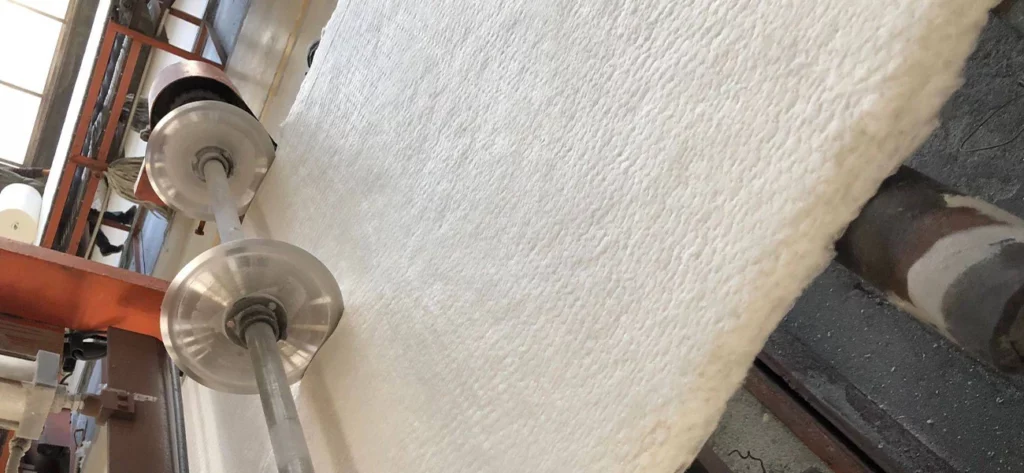
Ceramic fiber wool can operate continuously under extremely high temperatures:
This performance makes ceramic fiber wool suitable for most industrial heating environments.
Its thermal conductivity is much lower than conventional refractory materials. This means:
Unlike rigid bricks, ceramic fiber wool is lightweight, soft, and compressible. It adapts well to irregular surfaces, gaps, and difficult-to-insulate shapes.
Due to its insulation efficiency, ceramic fiber wool helps industries reduce emissions and energy waste.
Typical applications include:
Used for insulation of:
Used to insulate equipment that processes:
Ceramic fiber wool is used for insulation in:
Lower thermal conductivity means less heat escapes from furnaces.
Lightweight ceramic wool has low thermal mass, meaning equipment heats faster and uses less energy.
Thermal shock resistance reduces cracking and structural stress.
Raw fibers used for custom-shaped insulation.
Processed wool compressed into a flexible blanket.
For manufacturing boards, modules, and textiles.
Ceramic fiber wool can be:
Its flexibility makes installation simple and efficient.
Ceramic fiber wool is engineered to maintain insulation even at extreme temperatures. Its combination of light weight, low heat storage, and fiber structure minimizes convection and radiation heat transfer.
To ensure optimal performance, consider:
We offer superior ceramic fiber wool with consistent fiber distribution, low shot content, and stable long-term performance. Our products meet international industry standards and support a wide range of industrial applications.
| Ceramic fiber blanket index | ||||||||
| Type | Common | Standard | High Purity | High Aluminium | Zirconia | |||
| Classification temperature (℃) | 1100 | 1260 | 1260 | 1360 | 1400 | |||
| Working Temperature(℃) | <1000 | 1050 | 1100 | 1260 | 1350 | |||
| Color | White | Pure white | Pure white | Pure white | Pure white | |||
| Density (kg/m3) | 96/128/160 | 96/128/160 | 96/128/160 | 128/160 | 128/160 | |||
| Shrinkage on heating(%) | -4 | -3 | -3 | -3 | -3 | |||
| (24 hours,density as 128/m3) | (1000℃) | (1000℃) | (1100℃) | (1250℃) | (1350℃) | |||
| Thermal conductivity by different temperature (w/m.k)(density as 128kg/m3) | 0.09(400℃) | 0.09(400℃) | 0.09(400℃) | 0.12(600℃) | 0.16(800℃) | |||
| 0.16(800℃) | 0.16(800℃) | 0.16(800℃) | 0.20(1000℃) | 0.20(1000℃) | ||||
| 0.20(1000℃) | ||||||||
| Tensile strength (MPa) | 0.04 | 0.04 | 0.04 | 0.04 | 0.04 | |||
| (density as 128kg/m3) | ||||||||
| Chemical composition(%) | AL2O3 | 44 | 46 | 47-49 | 52-55 | 39-40 | ||
| AL2O3+SiO2 | 96 | 97 | 99 | 99 | ||||
| AL2O3+SiO2+ZrO2 | – | 99 | ||||||
| ZrO2 | 15-17 | |||||||
| Fe2O3 | <1.2 | <1.0 | 0.2 | 0.2 | 0.2 | |||
| Na2O+K2O | ≤0.5 | ≤0.5 | 02 | 0.2 | 0.2 | |||
| Ceramic Fiber Blanket Size | ||||||||
| Size | ||||||||
| Length(MM) | Width(MM) | Thickness(MM) | ||||||
| Ceramic Fiber Blanket | 14400/7200/3600 | 610/1220 | 6-50 | |||||
| Other specifications can be customized according to customer requirements | ||||||||


