Buscar en toda la estación

SS Reactor

SS Reactor

Scope of application

Stainless steel reactors are used for chemical synthesis, mixing, heating, cooling, and pressure reactions in laboratories and industrial production processes.

TEL+8618836556085

SS Reactor

A Stainless Steel Reactor, commonly referred to as an SS Reactor, is a closed processing vessel designed for carrying out chemical, biochemical, pharmaceutical, and industrial reactions under controlled conditions of temperature, pressure, agitation, and atmosphere. Due to its excellent corrosion resistance, mechanical strength, thermal stability, and hygienic properties, stainless steel reactors are widely used across modern process industries.

In industrial equipment manufacturing, the SS reactor has become a core component for chemical synthesis, polymerization, hydrogenation, fermentation, extraction, crystallization, and many other reaction processes.
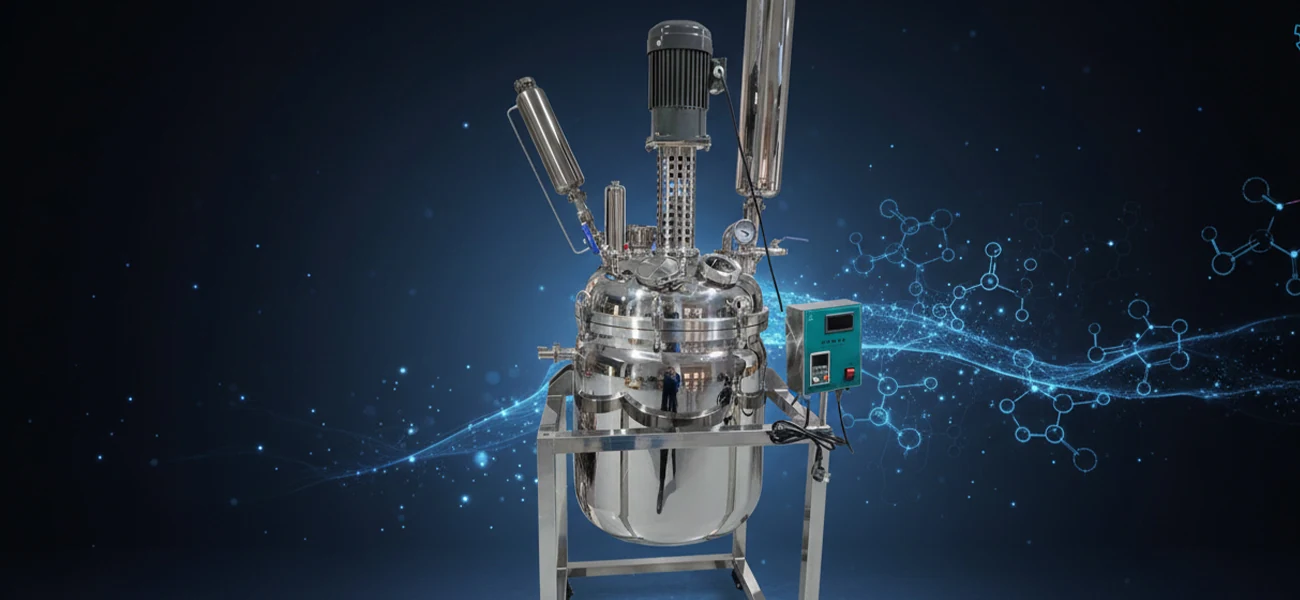
Stainless steel reactor

What Is a Stainless Steel Reactor?

A stainless steel reactor is a pressure-rated vessel fabricated primarily from SS304, SS316, or SS316L stainless steel, equipped with:

  • An internal agitation or mixing system
  • Heating and cooling jackets or coils
  • Process inlets and outlets
  • Instrumentation for temperature, pressure, and level control
  • Optional vacuum or pressure operation capability

SS reactors can operate in batch, semi-batch, or continuous modes, making them adaptable to a wide range of industrial production scales.


Working Principle of an SS Reactor

The working principle of a stainless steel reactor is based on creating a controlled reaction environment where raw materials are introduced, mixed, heated or cooled, and reacted under predefined process parameters.

Basic Operation Process

  1. Material Feeding
    Raw materials are charged into the reactor via top or side inlets.
  2. Mixing and Agitation
    An internal agitator ensures uniform temperature distribution and consistent reaction kinetics.
  3. Heat Transfer
    • Heating via steam, hot oil, or electric heaters
    • Cooling via chilled water or glycol systems
  4. Reaction Control
    Sensors and automation systems regulate temperature, pressure, and mixing speed.
  5. Discharge
    Finished products are discharged through bottom outlets or transfer pipelines.

Structural Components of a Stainless Steel Reactor

Reactor Vessel

  • Cylindrical or spherical design
  • Fabricated with ASME-compliant stainless steel plates
  • Polished internal surfaces for easy cleaning

Agitator System

  • Anchor agitator
  • Paddle agitator
  • Turbine agitator
  • Helical ribbon agitator

The agitator type depends on viscosity, reaction speed, and material characteristics.

Heating and Cooling Jacket

  • Single jacket
  • Dimple jacket
  • Half-pipe coil jacket
  • Internal cooling coils

Sealing System

  • Mechanical seals
  • Magnetic drive seals
  • Gland packing systems

Types of Stainless Steel Reactors

Batch Stainless Steel Reactor

Ideal for flexible production, R&D, and multi-product processing.

Continuous Stainless Steel Reactor

Used in large-scale industrial production with stable operating conditions.

High-Pressure SS Reactor

Designed for hydrogenation, polymerization, and synthesis under elevated pressures.

Vacuum Stainless Steel Reactor

Suitable for solvent recovery, distillation, and low-temperature reactions.


Common Materials Used in SS Reactors

  • SS304 – Cost-effective, suitable for non-corrosive environments
  • SS316 – Improved corrosion resistance
  • SS316L – Low carbon, ideal for pharmaceutical and biotech applications
  • Duplex Stainless Steel – High strength and chloride resistance (special cases)

Applications of Stainless Steel Reactors

Chemical Industry

  • Organic synthesis
  • Resin and polymer production
  • Pigments and coatings

Pharmaceutical Industry

  • API synthesis
  • Crystallization
  • Sterilization processes

Food and Beverage Industry

  • Flavor extraction
  • Enzyme reactions
  • Fermentation

Biotechnology

  • Cell culture
  • Enzymatic reactions
  • Bio-catalysis

Advantages of Stainless Steel Reactors

  • High corrosion resistance
  • Long service life
  • Excellent thermal conductivity
  • Easy cleaning and maintenance
  • Compatibility with automation systems

Limitations and Considerations

  • Higher initial cost compared to carbon steel
  • Not suitable for highly corrosive acids without lining
  • Requires skilled fabrication and welding

Selection Guide for SS Reactors

When selecting a stainless steel reactor, consider:

  • Reaction temperature and pressure
  • Corrosiveness of materials
  • Required volume and scalability
  • Mixing requirements
  • Compliance standards

Maintenance and Safety Practices

  • Regular inspection of welds and seals
  • Proper cleaning (CIP/SIP systems)
  • Pressure relief valve calibration
  • Operator training

Frequently Asked Questions (FAQ)

Q1: What is the difference between SS304 and SS316 reactors?
SS316 offers higher corrosion resistance, especially against chlorides.

Q2: Can SS reactors handle high-pressure reactions?
Yes, when designed according to ASME pressure vessel standards.

Q3: Are stainless steel reactors customizable?
Most industrial SS reactors are custom-designed based on process needs.

SS Reactor Technical Parameter

ModelBSF-10LBSF-20LBSF-30LBSF-50LBSF-100L
Power(W)200(1:3)
External dimensions(mm)540*480*1800550*700*1830550*700*1950700*600*2050700*800*2270
Number of cauldron lid openings8
Temperature measurement port50.5 chuck / φ8 temperature measuring tube50.5 chuck / φ12 temperature measuring tube
Drop hole50.5 mm chuck/1000 ml funnel50.5 mm chuck / 2000 ml funnel
Return hole50.5 chuck / φ3850.5 chuck / φ38
sight glassφ51φ89
sight glassφ32/
Feeding port/φ89
Pressure gauge port50.5 mm chuck / integrated pressure gauge
exhaust vent2-way exhaust valve
Mixing holeSUS316L propeller-type mixing impeller
High and low temperature resistance (°C)-120~260
Stainless steel thickness (mm)φ3φ4
Discharge valve port diameterφ35

SS Reactor Video

Teflon-Lined Stainless Steel Autoclave