Search the whole station
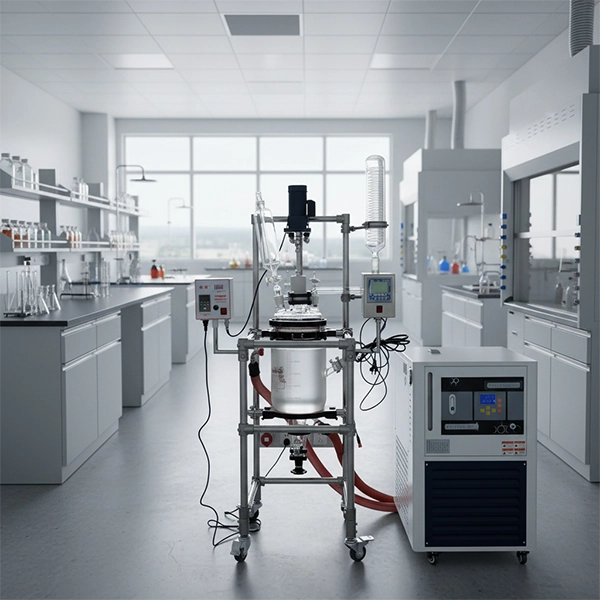
A laboratory jacketed glass reactor is a specialized piece of equipment used for chemical reactions that require strict temperature control. The reactor features a double-layer glass structure, where the inner vessel holds the reactants and the outer jacket circulates heating or cooling fluids.
This design ensures stable reaction conditions and efficient heat transfer, making jacketed glass reactors widely used in chemical laboratories, pharmaceutical research facilities, and pilot-scale production systems.
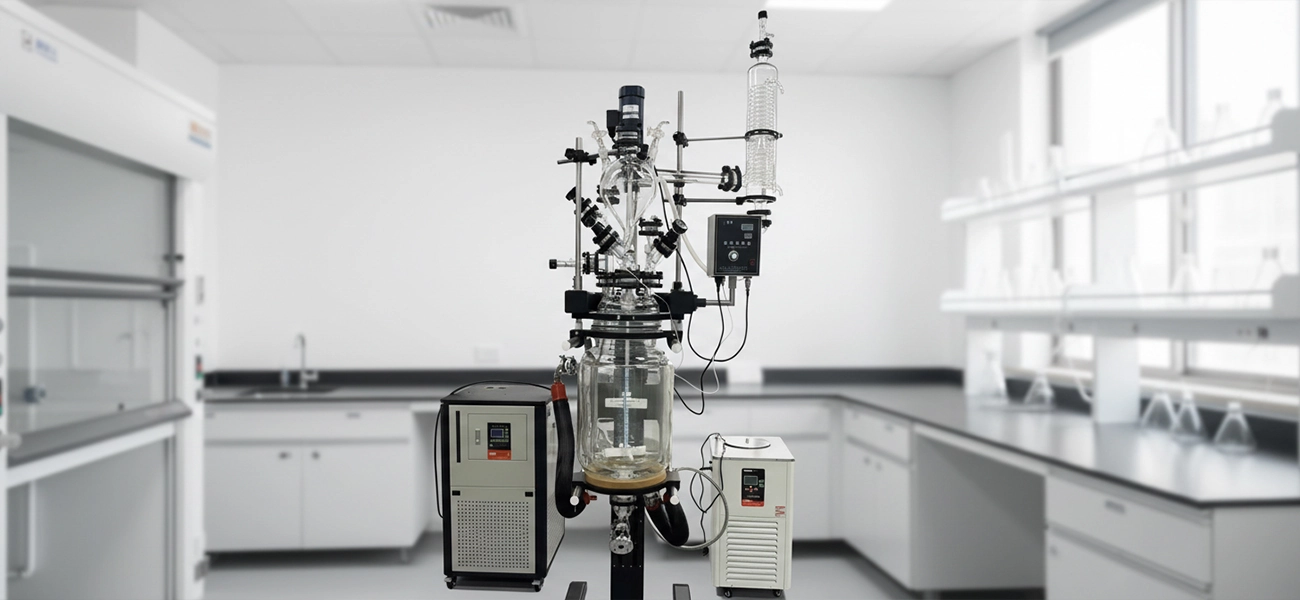
The working principle of a double jacketed glass reactor involves controlling temperature and mixing conditions during the reaction process.
The typical process includes:
This controlled environment ensures efficient and repeatable chemical reactions.
Different reactor configurations are available depending on laboratory requirements.
This type is commonly used in research laboratories for chemical synthesis and small-scale experiments.
A double jacketed glass reactor offers improved temperature stability and is suitable for complex chemical reactions.
Vacuum reactors operate under reduced pressure conditions and are commonly used for distillation, solvent recovery, and low-temperature reactions.
Jacketed glass reactors are used in many industries.
Used for drug synthesis, reaction optimization, and crystallization studies.
Suitable for organic synthesis, polymerization, and specialty chemical manufacturing.
Used for enzyme reactions and biochemical experiments.
Universities and research institutes use these reactors for advanced laboratory experiments.
Laboratory jacketed glass reactors offer several advantages.
These benefits make jacketed glass reactors ideal for complex chemical processes.
Proper maintenance is essential for ensuring long service life.
Important precautions include:
Following these guidelines helps maintain safe and reliable operation.
| Model | SF212-10 | SF212-20 | SF212-30 | SF212-50 | SF212-100 | SF212-150 | SF212-200 |
| Motor Power (W) | 120 / Explosion-proof 180 (Optional) | 120 / Explosion-proof 180 (Optional) | 120 / Explosion-proof 180 (Optional) | 120 / Explosion-proof 180 (Optional) | 200 / Explosion-proof 370 | 400 / Explosion-proof 750 | 400 / Explosion-proof 750 |
| Overall Dimensions (mm) | 500×500×2100 | 500×500×2200 | 540×540×2300 | 540×540×2520 | 640×640×2740 | 1040×740×3030 | 1200×810×3080 |
| Jacket Volume (L) | ≈3.8 | ≈5 | ≈8 | ≈15 | ≈20 | ≈40 | ≈45 |
| Lid Ports | 6 ports | 6 ports | 6 ports | 6 ports | 6 ports | 6 ports | 6 ports |
| Temperature Measuring Port | Φ35 with glass thermometer | Φ35 with glass thermometer | Φ35 with glass thermometer | Φ35 with glass thermometer | Φ35 with glass thermometer | Φ35 with glass thermometer | Φ35 with glass thermometer |
| Dropping Funnel Port | #40 / 1000 ml constant-pressure funnel | #40 / 1000 ml constant-pressure funnel | #40 / 1000 ml constant-pressure funnel | #40 / 1000 ml constant-pressure funnel | #40 / 2000 ml constant-pressure funnel | #40 / 2000 ml constant-pressure funnel | #40 / 2000 ml constant-pressure funnel |
| Reflux Port | Φ50 ball joint / 500 ml reflux condenser | Φ50 ball joint / 500 ml reflux condenser | Φ50 ball joint / 500 ml reflux condenser | Φ50 ball joint / 500 ml reflux condenser | Φ50 ball joint / 1000 ml reflux condenser | Φ50 ball joint / 1000 ml reflux condenser | Φ50 ball joint / 1000 ml reflux condenser |
| Feeding Port | Φ80 | Φ80 | Φ80 | Φ80 | Φ125 | Φ125 | Φ125 |
| Liquid Inlet | #34 glass valve | #34 glass valve | #34 glass valve | #34 glass valve | #34 glass valve | #34 glass valve | #34 glass valve |
| Stirring Port | Φ60 four-blade | Φ60 four-blade | Φ60 four-blade | Φ60 four-blade | Φ60 four-blade | Φ60 four-blade | Φ60 four-blade |
| Pressure Gauge | Integrated vacuum pressure gauge | Integrated vacuum pressure gauge | Integrated vacuum pressure gauge | Integrated vacuum pressure gauge | Integrated vacuum pressure gauge | Integrated vacuum pressure gauge | Integrated vacuum pressure gauge |
| Lid Outer Diameter (mm) | 265 | 265 | 265 | 265 | 340 | 340 | 340 |
| Kettle Outer Diameter (mm) | 290 | 330 | 365 | 410 | 500 | 550 | 650 |
| Lid Opening Diameter (mm) | 265 | 265 | 265 | 265 | 340 | 340 | 340 |
| Lid Inner Diameter (mm) | >215 | >215 | >215 | >215 | >285 | >285 | >285 |
| Vessel Height (mm) | <450 | <550 | <730 | <850 | <950 | <980 | <1050 |
| Vessel Inner Diameter (mm) | 290 | 330 | 365 | 410 | 500 | 550 | 650 |
| Discharge Port Outer Diameter (mm) | Φ32 | Φ32 | Φ32 | Φ32 | Φ32 | Φ32 | Φ32 |
| Discharge Port Inner Diameter | DN25 | DN25 | DN25 | DN25 | DN25 | DN25 | DN25 |