Поиск по всей станции
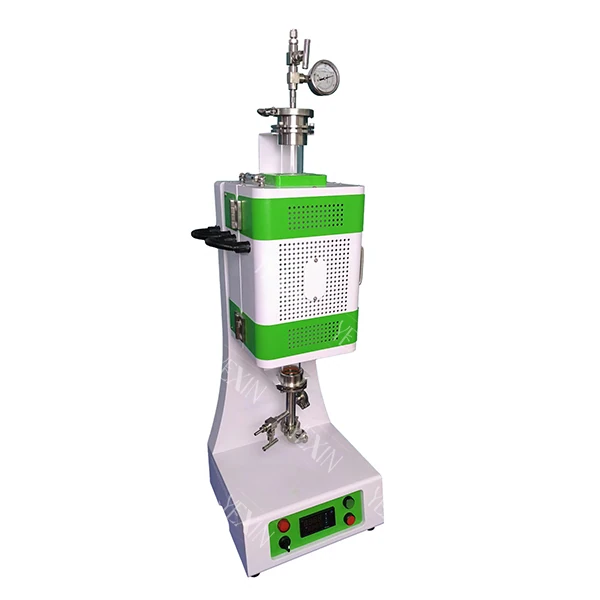
A vertical tube furnace is a hot-wall heating device with vertically arranged tubes. Its structural design centers around a vertical tube, typically made of annealed quartz. Surrounded by a multi-zone heater (typically divided into three or four zones), the furnace maintains uniform temperature distribution through convection and radiation. Gas enters the furnace tube from the front (near the door), flows through a vertically positioned sample boat, and then is exhausted through a vacuum system or exhaust system, creating a closed or controlled atmosphere for the reaction.

The vertical layout offers key advantages:
The sample boat can be stably positioned within the furnace tube by gravity or mechanical means, reducing the uneven thermal gradients encountered with horizontal placement.
The vertical structure facilitates integration with automated loading and unloading systems, making it particularly suitable for mass production.
The sealed bottom of the furnace tube facilitates high vacuum or inert atmosphere control, minimizing the risk of gas leaks.
Core Performance Advantages
Heat Field Uniformity: The vertical layout reduces the interference of gas convection on temperature distribution. Combined with multi-zone heating technology, the axial temperature difference within the furnace tube can be controlled within ±3°C, making it suitable for temperature-sensitive processes such as thin film deposition and crystal growth.
Process Compatibility: Compatible with semiconductor processes such as LPCVD (low-pressure chemical vapor deposition) and oxidation diffusion, it is particularly suitable for applications requiring vertical substrate placement (such as batch processing of silicon wafers and ceramic substrates).
Improved Safety: The furnace door of the vertical furnace tube is typically located at the top or bottom, avoiding direct exposure to high-temperature areas during operation and reducing the risk of burns. Furthermore, the vertical structure facilitates the integration of safety devices such as over-temperature alarms and gas leak detection.
Typical Applications:
Semiconductor Manufacturing:
In integrated circuit production, it is used for oxidation and doping processes in silicon wafers. For example, by introducing oxygen and chlorine gases, uniform silicon dioxide thin films are grown on the surface of silicon wafers within the vertical furnace tube, with film thickness uniformity controlled within ±2%.
New Material Research and Development:
It is suitable for the high-temperature synthesis of nanomaterials (such as carbon nanotubes and two-dimensional materials). Vertical furnace tubes provide a stable temperature environment and gas flow conditions, promoting directional growth of materials on the substrate surface.
Ceramics and Powder Metallurgy
Used for sintering ceramic powders or heat treating metal powders, the vertical layout facilitates continuous feeding and improves production efficiency. For example, in the preparation of magnetic materials, the controlled atmosphere sintering of vertical furnace tubes can reduce material oxidation and improve magnetic properties.
| Model | YXV- 1200-V1 |
| Furnace tube specifications | 50*42*500mm(outer diameterinner diameterlength)with 5-10micron sand core layer in the middle |
| Operating voltage | Single-phase AC220V,50/60Hz |
| Heating element | High-quality HRE heating wire |
| Operating temperature | Maximum temperature:1200℃(≤30min)Long-term working temperature:1100℃ Recommended heating rate:5-20℃/min |
| Heating zone | Heating zone length:220mm Constant temperature zone length:60mm(±3℃) |
| Control method | The fully automatic control system automatically operates from room temperature to the set temperature after programming.The system utilizes thyristor control and a modular temperature control system design,resulting in a simple structure and easy maintenance.The instrument utilizes a 30-segment programmable meter,allowing for freely set constant temperature and holding curves with interference-free switching. The meter also features temperature correction and compensation functions. |
| Security Features | Over-temperature alarm and door-opening power-offfunction |
| Features | Standard three-color status reminder function:blue for waiting,green for running, and red for abnormality(with buzzer) |
| Display accuracy | ±1℃ |
| Sealing system | Both ends of the furnace tube are equipped with quick-opening flanges. (Including precision needle valve,pointer vacuum pressure gauge,hose connector,etc.) |
| Atmosphere | Various atmospheres such as oxygen,nitrogen,argon,etc. |
| Temperature measuring element and temperature measuring range | K-type thermocouple,temperature measurement range 0-1200℃,the thermocouple is close to(contacting)the outer wall of the tube,which can reduce the surface temperature to room temperature and make the inner cavity temperature uniform. |
| Air cooling system | The fan impeller is directly mounted on the bottom of the double-layer furnace shell and assembled with the control system.When heating,air cooling is performed to reduce the surface temperature of the furnace shell and protect the electrical equipment from heat dissipation,making operation safer for personnel and improving efficiency |
| refractory materials | The furnace lining is made of high-quality high-purity alumina fiber,vacuum-formed fiber polylight board material,and lightweight hollow ball alumina board.It has high operating temperature,small heat storage,resistance to rapid heating and cooling,no cracks,no slag,and good thermal insulation performance(the energy saving effect is more than 80%of the old electric furnace). |
 xuye
xuye