Поиск по всей станции
Scope of application
It is widely used in the vapor phase synthesis of nanomaterials, such as the CVD growth of carbon nanotube arrays (the horizontal placement of the substrate facilitates uniform gas diffusion) and the vapor phase deposition of oxide nanowires (VLS mechanism). In energy material research, it is used for high-temperature sintering of fuel cell electrolytes and annealing treatment of perovskite solar cell materials..
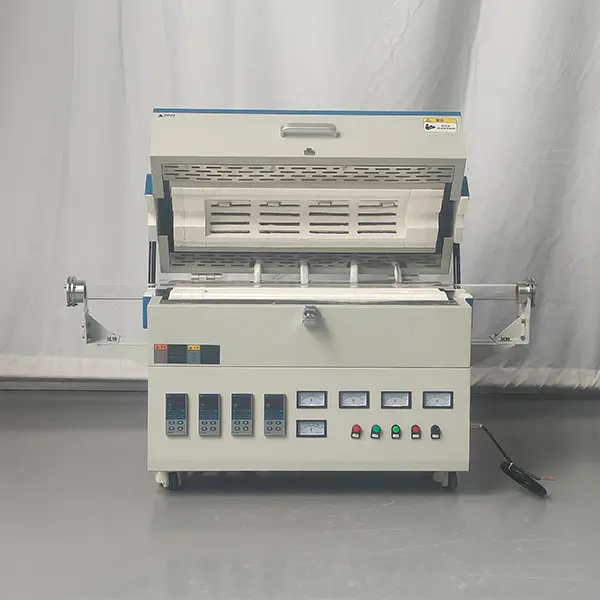
A horizontal tube furnace is a heating device with horizontally positioned tubes. Its compact design and high space efficiency make it suitable for both laboratory and small-scale industrial production. Its core advantages include the following:
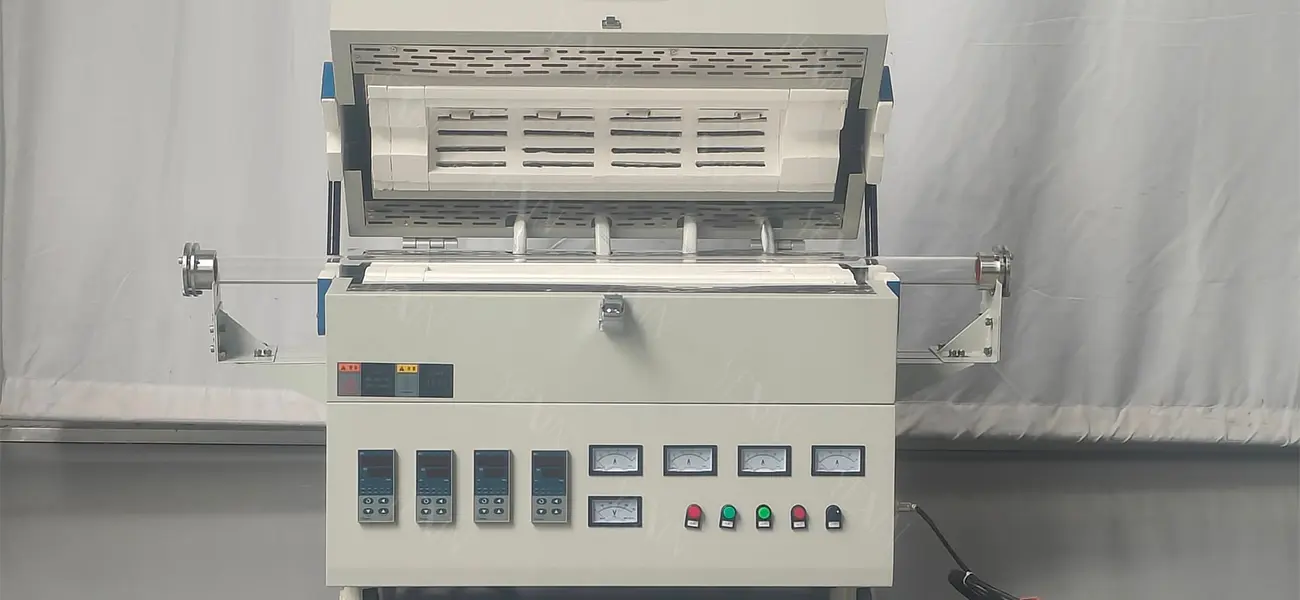
Precise Temperature Control: It supports independent control of multiple temperature zones, enabling gradient heat treatment. For example, materials can experience continuously varying temperatures from one end to the other, simulating complex industrial conditions. High-temperature stability reaches 1600°C, and the furnace maintains high temperature uniformity. The surrounding layout of the heating elements and the horizontal tube design prevent localized overheating or underheating.
Controllable Atmosphere and Vacuum Environment: It can effectively evacuate the furnace and introduce inert or reactive gases such as nitrogen and argon to prevent degradation of sensitive materials at high temperatures and ensure material purity.
Strong Material Processing Uniformity: Some models feature a rotation and tilt function, allowing powders or long strips of material to tumble during heating, further improving temperature uniformity.
Main Applications: Horizontal tube furnaces, with their superior temperature and atmosphere control, are widely used in:
Materials Science Research: Heat treatments such as sintering, annealing, and quenching of ceramic, glass, and metal powders. Sensitive material processing: Processes for oxygen-sensitive electronic materials, metal powders, and other materials that require an oxygen-free environment.
Small-scale industrial production: Used for gradient material performance control or continuous processing in the metallurgical, chemical, and electronics fields.
| Model | Max temperature | Heating zone length | Constant temperature zone length | Power and voltage | Furnace tube size | Dimensions |
| YXG-1200-A1 | 1200℃ | 200mm | 60mm | 1.5kW/AC220V | φ30/50*500mm | 800*340*400mm |
| YXG-1200-A2 | 1200℃ | 440mm | 120mm | 3kW/AC220V | φ30/100*1000mm | 1120*480*530mm |
| YXG-1200II-200 | 1200℃ | 200+200mm | 200mm | 3KW/AC220V | φ30/100*1000mm | 1100*420*560mm |
| YXG-120OIII-200 | 1200℃ | 3*200mm | 3*60mm | 4.5KW/AC220V | φ30/100*1000mm | 1400*420*560mm |
| YXG-1400-400 | 1400℃ | 400mm | 120mm | 5kW/AC220V | φ30/100*1000mm | 1200*500*660mm |
| YXG-140OIl-200 | 1400℃ | 200+200mm | 200mm | 5kW/AC220V | φ30/100*1000mm | 1200*500*660mm |
| YXG-1700-290 | 1700℃ | 290mm | 80mm | 6kW/AC220V | φ30/100*1000mm | 1300*640*870mm |