Поиск по всей станции
A stainless steel reactor is a core piece of industrial equipment used to carry out chemical, physical, and biochemical reactions under controlled conditions. In B2B industrial environments, stainless steel reactors are valued for their structural strength, corrosion resistance, stable performance, and long service life. They are widely deployed in chemical manufacturing, pharmaceuticals, food processing, energy, environmental protection, and advanced materials production.
For industrial buyers, a stainless steel reactor is not only a reaction vessel but a complete processing solution that integrates mixing, heating or cooling, pressure control, and automation. Compared with glass-lined or carbon steel reactors, stainless steel reactors offer a balanced combination of durability, hygiene, flexibility, and cost efficiency, making them suitable for both pilot-scale and large-scale continuous production.
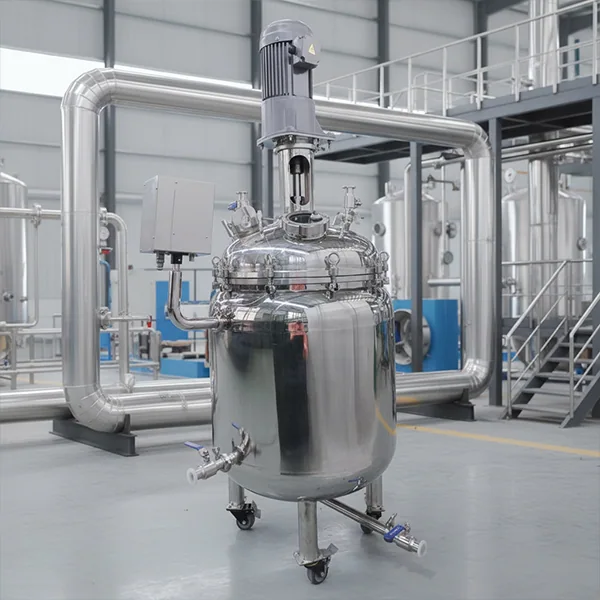
An industrial stainless steel reactor is a pressure-rated vessel fabricated from stainless steel materials such as SS304, SS316, or SS316L. It is designed to safely contain reactants and facilitate reactions under specified temperature, pressure, and agitation conditions. The reactor may operate in batch, semi-batch, or continuous modes depending on the production process.
In industrial applications, stainless steel reactors are often customized to match process parameters, including working volume, operating pressure, heat transfer requirements, and chemical compatibility. This customization capability makes them ideal for B2B customers who require process stability, repeatability, and scalability.
The reactor vessel is the main body, manufactured from thick stainless steel plates or forgings. It is engineered according to pressure vessel standards and designed to withstand thermal cycling, internal pressure, and mechanical stress. Surface finishes such as mirror polishing or sandblasting can be selected based on hygiene and cleaning requirements.
Efficient mixing is essential for reaction uniformity and heat transfer. Industrial stainless steel reactors may use anchor agitators, paddle mixers, turbine impellers, propellers, or helical ribbon designs. The agitator type is selected based on material viscosity, reaction speed, and process goals.
Temperature control is achieved through jackets, half-pipe coils, or internal coils. Heating media typically include steam, thermal oil, or electric heaters, while cooling media may include water or glycol. Accurate temperature control improves yield, product quality, and operational safety.
Mechanical seals, magnetic couplings, safety valves, rupture disks, and pressure gauges ensure stable and safe operation. For hazardous or high-pressure processes, additional safety interlocks and emergency relief systems can be integrated.
Modern stainless steel reactors are equipped with temperature sensors, pressure transmitters, level indicators, and automated control systems. PLC or DCS integration allows precise control and data logging, which is critical for industrial consistency and regulatory compliance.
SS304 is widely used for general industrial applications with mild corrosive conditions. It offers good mechanical strength and cost efficiency.
SS316 contains molybdenum, providing enhanced resistance to chlorides and corrosive chemicals. It is suitable for more demanding chemical processes.
SS316L has low carbon content, reducing the risk of intergranular corrosion. It is commonly used in pharmaceutical, food, and high-purity applications.
Material selection directly affects reactor lifespan, maintenance cost, and process safety, making it a key consideration for B2B buyers.
Stainless steel reactors are used for polymerization, esterification, neutralization, hydrogenation, oxidation, and other chemical reactions. Their corrosion resistance and thermal stability support long-term industrial operation.
In pharmaceutical manufacturing, stainless steel reactors are designed to meet GMP standards. They are used for API synthesis, crystallization, extraction, and solvent recovery processes.
Food-grade stainless steel reactors are used in fermentation, blending, enzymatic reactions, and flavor production. Smooth internal surfaces ensure hygiene and ease of cleaning.
In biochar production, biomass conversion, activated carbon regeneration, and waste treatment, stainless steel reactors provide resistance to high temperatures, corrosive gases, and by-products.
| Model | BSF-10L | BSF-20L | BSF-30L | BSF-50L | BSF-100L |
| Power(W) | 200(1:3) | ||||
| External dimensions(mm) | 540*480*1800 | 550*700*1830 | 550*700*1950 | 700*600*2050 | 700*800*2270 |
| Number of cauldron lid openings | 8 | ||||
| Temperature measurement port | 50.5 chuck / φ8 temperature measuring tube | 50.5 chuck / φ12 temperature measuring tube | |||
| Drop hole | 50.5 mm chuck/1000 ml funnel | 50.5 mm chuck / 2000 ml funnel | |||
| Return hole | 50.5 chuck / φ38 | 50.5 chuck / φ38 | |||
| sight glass | φ51 | φ89 | |||
| sight glass | φ32 | / | |||
| Feeding port | / | φ89 | |||
| Pressure gauge port | 50.5 mm chuck / integrated pressure gauge | ||||
| exhaust vent | 2-way exhaust valve | ||||
| Mixing hole | SUS316L propeller-type mixing impeller | ||||
| High and low temperature resistance (°C) | -120~260 | ||||
| Stainless steel thickness (mm) | φ3 | φ4 | |||
| Discharge valve port diameter | φ35 | ||||

 xuye
xuye